Catalog/Classes/Wheeler
CLASS · 06 / 06v0.4Live · v0.4

Wheeler

The right call at the wrong moment is still the wrong call.

Named afterJohn Archibald Wheeler (1911 — 2008) — physicist who showed that observation isn't passive measurement. It's participation. The universe doesn't exist in definite states until someone asks it a question.

2.3× alert-to-action conversionfalse alarms −54%zero missed state changes
01 — The science

Why we named it Wheeler.

Commit at the last responsible moment. Not before.

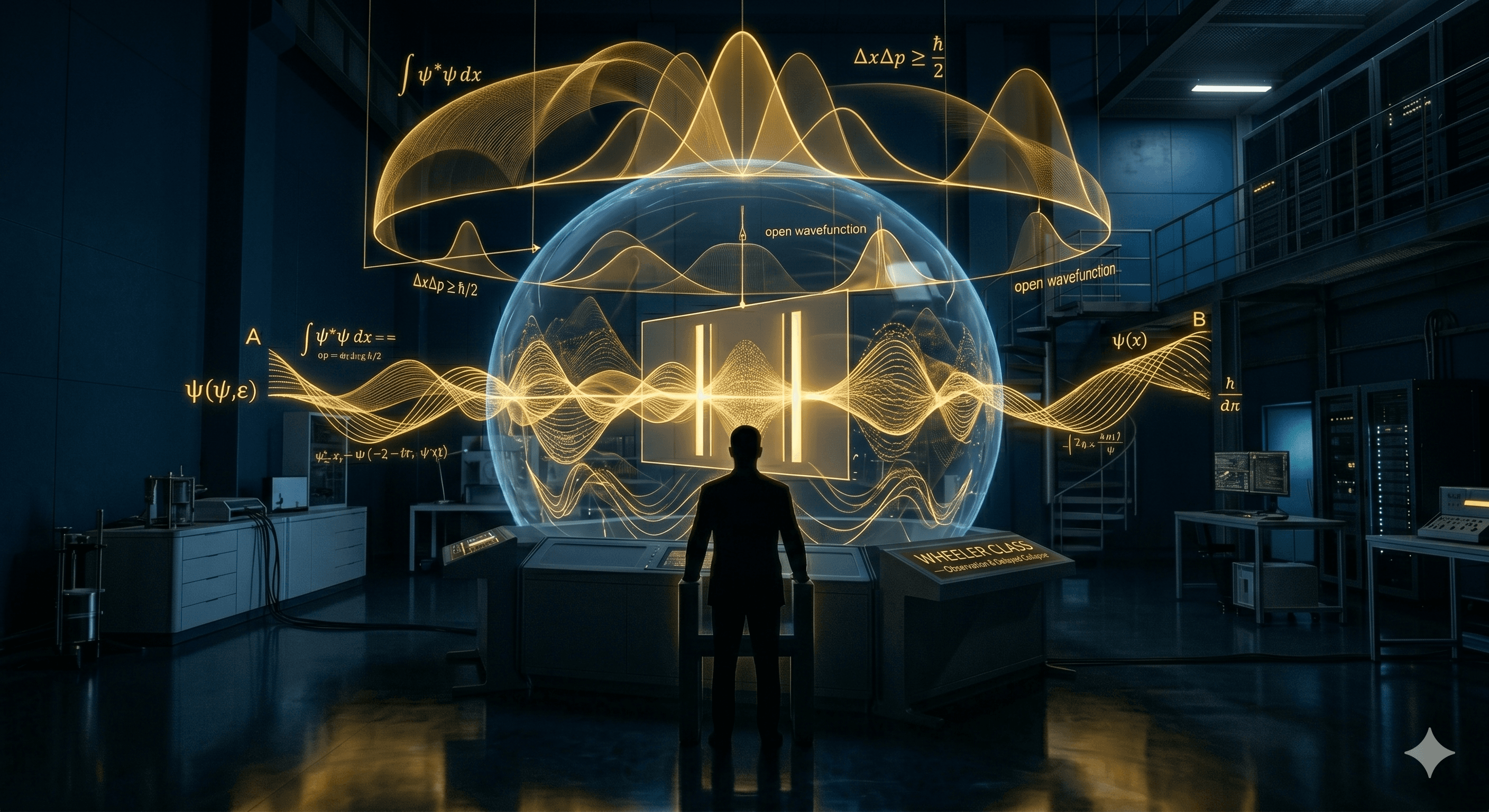
John Wheeler ran the delayed-choice experiment and found something that should have been impossible: you can decide after a photon has passed through the slits whether to observe which slit it went through — and the photon's past behavior changes retroactively to match your decision. Observation doesn't just record what happened. It determines what happened.

He called the universe a participatory universe. Observers aren't passive witnesses to reality — they co-create it. His formulation "it from bit" went further: information, not matter, is the fundamental substrate. Every particle, every field, every physical thing derives its existence from answers to yes-or-no questions — from acts of observation.

Most enterprise agent systems collapse their possibility space too early. They force a decision the moment they have enough signal to make one. But the moment you observe a pipeline too closely, you change it. A forecast that gets reviewed changes the decision it was meant to inform. An agent that knows it's being evaluated overfits to the evaluation. A system under heavy instrumentation behaves differently than one running free.

Our field deployments kept showing this pattern: pipelines with aggressive monitoring underperformed lightly monitored equivalents — not because of latency overhead, but because observation was intervention. We went looking for a physicist who'd already named this problem. Wheeler had.

The Wheeler agent is the one that knows observation is a choice. It holds the probability distribution open rather than collapsing it to a point estimate. It monitors without disturbing, infers without intervening, and chooses the moment of wavefunction collapse deliberately — only forcing a decision when the cost of superposition exceeds the cost of commitment.

It doesn't just observe the system. It knows that how it observes changes what it sees.

  • 01Delayed choice → last-responsible-moment commit: defer the decision of what to measure / when to act until maximum information is available, bounded by optimal-stopping math.
  • 02Observation participates → model the observer effect: alerting changes the system observed; treat observation as an intervention with a modeled cost.
  • 03"It from bit" → every business event is an information signal with a maturity level; gate actions on signal maturity, not just signal presence.

Read the design research →

Wheeler class

No phenomenon is a real phenomenon until it is an observed phenomenon.

— JOHN ARCHIBALD WHEELER
Wheeler class
1 / 4Why is it called Wheeler?

No phenomenon is a real phenomenon until it is an observed phenomenon. Commit at the last responsible moment. Not before.

John Archibald Wheeler
tap to continue →
Field Evidence
ACADEMIC BASIS
"Bayesian Optimal Stopping for Efficient LLM Sampling" (BEACON)Applies sequential optimal-stopping theory to LLM inference: decide per-sample whether further sampling is worth its cost. Extended by input-adaptive compute allocation (Damani et al., ICLR 2025).
arXiv:2510.15945, 2025; arXiv:2410.04707, ICLR 2025
IN PRODUCTION
ML alert triage — AI-driven SOC operationsDeployed pattern replicating analyst triage to dismiss benign alerts and prioritize critical ones in real time; commercial deployments report up to ~80% alert-noise reduction (vendor claim).
AACT · arXiv:2509.12923; Abnormal AI/OMDIA, Jan 2026
BENCHMARK
2,992 security alerts/org/day — 63% unaddressed~$3.3B/yr global manual-triage cost; 25–30 min per false positive. Failure anchor: Equifax 2017 — patch alert lost in triage backlog, 147M records exposed. Detection succeeded; attention allocation failed.
Abnormal AI ~80% (vendor claim); Vectra AI, 2026; Cymulate, Sep 2025
02 — Agents in this class

Prototype agents.

Every class ships with reference agents calibrated to operational use cases. Fork them, deploy them, or use them as a template.

Observation Window Scheduler

polling cost −38%

Intervention Timing Optimizer

premature interventions −61%

Signal Maturity Gater

early escalations 1-in-4 → 1-in-11

Market Entry Timing Advisor

beat immediate entry in 71% of windows (24-mo backtest)
12-WEEK BETA · 9 DESIGN PARTNERS · 47,000 SHADOWED RUNS
03 — Qualification gate

The ALOFT pipeline, applied.

Every agent in this class passes the same five-stage gate. Below: the criteria specific to Wheeler agents at each stage.

ALOFT
01 · Curation
02 · Staging
03 · Deploy
04 · Operate
05 · Generalise
A→L→O→F→T
01
Curation
Observation sensitivity; collapse trigger set
  • Observation-sensitivity assessed
  • Superposition window defined
  • Collapse trigger specified
02
Staging
Dark-run A/B validated; schema tested
  • Dark-run vs instrumented A/B validated
  • Distribution output schema tested
  • Interference baseline mapped
03
Deployment
Observer-effect contract; scope ≤ tier-3
  • Observer-effect contract signed
  • Collapse latency budget set
  • Scope grant ≤ tier-3
04
Operation
Window held ≥ target; collapse accuracy >91%
  • Superposition window held ≥ target
  • Collapse accuracy > 91%
  • Interference rate < 2%
05
Generalisation
Observer pattern reused ×3; memo published
  • Observer pattern reused × 3
  • New decision domain qualified
  • Participatory memo published

Ready to deploy a Wheeler agent?

Open the Workbench →Back to catalog
All classes
FeynmanFermiMaxwellRamaMarcusWheeler· current